Showing posts with label Historical Events. Show all posts

Tuesday, June 1, 2010

Kent State Massacre by Jerilyn Nick


  • Kent State Massacre


  • Sergent Taylor. National Guard. College Students; deceased includes: Jeffery Miller, Sandra Lee Scheuer, Allison Krause, and William Knox Schroeder, with several others wounded.


  • May 4, 1970


  • Kent State University, Kent, Ohio


  • On May 4, 1970, over 2,000 college students gathered at Kent State University near Taylor Hall to protest President Richard Nixon's address on the American invasion of Cambodia. The National Guard was called in, for the campus had disapproved of the rally and feared violence would erupt. After several attempts to disperse the crowd, the National Guard fired on the students, the shootings lasting about 13 seconds. 4 students were killed, 2 of which passerbyes trying to go to class, and several others were injured and/or paralyzed.


  • A photograph of a teenager screaming over the body of one of the victims earned the Pulitzer Prize.


  • The Kent State Massacre shook the nation. Protests sparked across colleges and other school across the country, and over 10,000 people rioted in Washinton, DC 5 days after the massacre. People were furious at the deaths, but the public was divided on whom to blame for the incident: the Guard for firing, or the students for refusing to dispurse. Over 900 schools were closed during the riots. On June 13th of that year, the president put together the Scranton Commission to figure out if the shootings were justified. They later ruled that they were not.

Because of it's name, the Kent State Massacre is often compared to the Boston Massacre, in which British soldiers fired upon a group of colonists, killing some and injuring numerous others.


  • Due to the massacre, the National Guard has had to improve it's methods of crowd control to less leathal ways. The question of self defense was also tested, as well as where the line determining that should be drawn. The riots that occured afterwards demonstrated the public's opposition to the shootings, and the invasion of Columbia. Because of that, another question of whether the riots were "student protest" or "civil war" was raised, for the president had to stay at Camp David during the time, and soldiers stood by to prevent the public from extentive violence.

Source: http://en.wikipedia.org/wiki/Kent_state_massacre

Indian Self-Determination Act of 1975 by Jerilyn Nick

Indian Self-Determination Act of 1975


  • Important People Involved: President Nixon; Native American population

  • January 4, 1975
  • The Indian Self-Determination (and Education Assistance) Act of 1975 was a law passed by President Richard Nixon in order for government agencies such as Secretaries of Education, Health, and Welfare to establish contracts with Indian tribes. Through those contacts, Native American tribes were able to gain financial grants in order to build things such as a health clinic. This allowed the tribes to be able to manage their societies and finances better than before, without being assimilated and/or their tribes being assimilated.
  • As stated above, the Indian Self-Determination Act of 1975 provided federally recognized Native American tribes with financial support from government agencies. Prior to the passing of the act, the government focused more on assimilating the Native American population and terminating their tribes. The Act served to reverse that effort, giving more control and freedom to the tribes.

Source: http://en.wikipedia.org/wiki/Indian_Self-Determination_and_Education_Assistance_Act_of_1975

Terracotta Army by Zaharina Velazquez

Important People Involved:
- Chinese Farmers
- archeologist


When and Where:
The Terracotta Army was first discovered in 1974 in the Xi'an, Shaanxi province of China near the Mausoleum of the First Qin Emperor.

What Happened:
In 1974, local farmers were digging a well when they stumbled upon a pit full of life sized statues. This lead to the excavation of the area and a total of three pits begin found. Each pit is believed to be about 230 meters long and about 7 meters deep. Inside the first pit archeologists found the main army consists of 8,000 figures. In the second pit they found chariots, cavalry and infantry in a U-shape. And finally the third pit contained the commanding headquarters. The army is said to be a replica of Emperor Qin's warriors with over 8,000 soldiers, 130 chariots with 520 horses and 150 cavalry horses. Historians believe there are more to be found.


Effects and Significance:
The discovery of the Terracotta Army lead to the most successful year at the British Museum in London. the exhibit consists of 120 objects from the mausoleum and 20 warriors. The Terracotta Army exhibition sold out tickets so fast that the museum had to extend hours until midnight and even them people still had to be turned away.
This discovery is important because it taught us a lot about the past. Thanks to this discovery we learned about the skills of the people in ancient times. We also learned about the high levels of mercury that were present in the soil. And now we have a human made wonder which only a select few have been able to walk through.

Thursday, May 27, 2010

Roe Vs. Wade by Zaharina Velazquez


Important people involved:
-Norma L. McCorvey (Jane Roe)
-Attorneys Linda Coffee and Sarah Weddington
-Dallas District Attorney Henry Wade
-Chief Justice Warren E. Burger
-Justice Harry Blackmun

When and Where:
The courts decision was made on January 22, 1973. Taking place in the U.S. District Court in Texas after reaching the Supreme Court in 1972.

What Happened:
In 1969, single Norma L. McCorvey discovered she was pregnant and decided she did not want the child. Texas law (at the time) allowed a woman carrying a child product of rape or incest to abort, so she claimed to have been raped. Because she had not filed a report with the police she was rejected the abortion. This eventually led her to hiring attorneys Linda Coffee and Sarah Weddington who filed a suit in the Texas court. After much dispute and many years in court, the case went to the Supreme Court were the decision was made based on the Nineteenth Amendment. The amendment protecting a persons right to privacy is broad enough to allow a woman decide whether or not she wishes to continue her pregnancy.

Order of Events:
1969- Norma L. McCorvey pregnant but doesn’t want baby
1970- Hires attorneys and goes to court.
1972- Case reaches Supreme Court on appeal.
1973- Decision made with a 7 to 2 majority in favor.

Outcomes:
The important outcome of this event was the over turning of Texas interpretation of abortion law, thus making abortion legal. This case decision stated that a woman could have an abortion in early months of pregnancy with no restrictions and with some restrictions in later months. This decision has lead to a LOT of controversies in the years following it.

Effects and Significance:
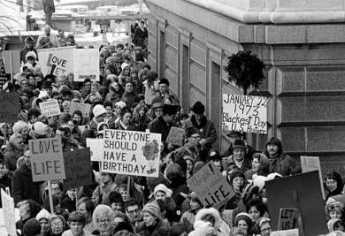
After the decision was made there was an uprise through protest. Two groups arose, pro-life supporters and pro-choice supporters, both of whom to this day continue to fight for their cause. Pro-life supporters believe that life begins at conception and therefore and abortion is taking a life. An abortion is not only a form of murder but a violation to the right to live. Pro-choice supporters believe that a woman should have the right to choose whether she wants to have the child or not.
This event is important because it is still a hot topic today. Every year, on the anniversary of the final decision to the case, people protest. Pro-life supporters continue to fight to make abortion illegal and add restrictions to it while pro-choice support the courts decision. Today, many states are unsure of what to do in response to the topic and so it is important to know how and why this was all started.